

Many small businesses know they need to manage health Small businesses often use contractors.
A builder brings in a sparky.
An orchard brings in a pruning crew.
A rural contractor brings in a digger operator.
A business owner gets someone in to fix, spray, trim, cut, install, move, or maintain something.
And the common thought is:
“They’re a contractor, so they manage their own safety.”
That is partly true.
But it is not the full story.
Under the Health and Safety at Work Act 2015 (HSWA), more than one business can have health and safety duties at the same time. WorkSafe explains that when businesses work together, they will likely share health and safety duties. These are called overlapping duties.
So, if you engage contractors, you need a simple way to manage that relationship without drowning in paperwork.
This article explains contractor management in plain English.
What Is Contractor Management?
Contractor management means making sure contractors are:
- Clear about the work
- Clear about the risks
- Clear about site rules
- Competent for the job
- Communicating properly
- Following agreed controls
It does not mean you control every small task they do.
It does mean you take reasonable steps to make sure the work is planned and managed safely.
WorkSafe is clear that PCBUs cannot contract out of their health and safety duties or push risk onto others in a contracting chain. PCBUs can make reasonable agreements about who will do what, but they must monitor each other to make sure duties continue to be met.
That is the key.
You can agree roles.
You cannot hand away responsibility.
Why Contractor Management Matters
Contractor work can create serious risks.
For example:
- Vehicle movement
- Working at height
- Chemicals
- Excavations
- Machinery
- Public access
- Overhead or underground services
- Chainsaws or vegetation work
If contractors arrive onsite without clear communication, gaps appear fast.
One business assumes the other has traffic sorted.
Another assumes inductions are covered.
Someone else assumes workers know the emergency plan.
Assumptions create risk.
Good contractor management removes guesswork.
Step 1: Choose the Right Contractor
Before work starts, ask simple questions.
- Has this contractor done this type of work before?
- Do they understand the risks?
- Do they have relevant training or competency?
- Do they have suitable equipment?
- Do they have insurance where needed?
- Can they explain how they will manage high-risk work?
You do not need to turn this into a 50-page tender process.
But you should check that the contractor is suitable for the job.
For higher-risk work, you may need more evidence.
For lower-risk work, a simple check may be enough.
The level of checking should match the level of risk.
Step 2: Be Clear About the Work
Before the contractor starts, make sure everyone understands:
- What work is being done
- Where it is happening
- Who else will be onsite
- What risks are already present
- What risks the contractor may create
- Who controls which parts of the work
This is where many businesses fall down.
They tell the contractor what needs doing, but not what they need to know.
For example:
- “There are workers in that block today.”
- “The public may enter through this gate.”
- “The ground is soft near that drain.”
- “Spraying happened yesterday.”
- “There are overhead lines near the access track.”
That information matters.
Step 3: Consult, Cooperate, and Coordinate
This is the heart of contractor management under HSWA.
Where duties overlap, PCBUs must, so far as reasonably practicable, consult with each other, cooperate with each other, and coordinate their activities. WorkSafe also explains that each PCBU remains responsible for making sure its own duties are met.
In plain English:
Talk to each other.
Work together.
Make sure the plan makes sense.
This could look like:
- A pre-start meeting
- A shared risk discussion
- A site induction
- A short contractor checklist
- A simple site-specific safety plan
- Regular check-ins during the job
It does not need to be complicated.
It needs to be clear.
Step 4: Monitor the Work
Once the contractor starts, your job is not finished.
WorkSafe says monitoring a contract is part of the overlapping duty to consult, cooperate, and coordinate with other PCBUs that share duties. Monitoring can include making sure parties know their roles and responsibilities and taking overall responsibility for control and coordination of the contract.
For a small business, monitoring might be simple:
- Check the contractor has arrived and understands the site
- Confirm high-risk controls are in place
- Walk the site occasionally
- Ask if anything has changed
- Check incidents or near misses are reported
- Follow up if agreed controls are not being used
Monitoring is not spying.
It is checking that the agreed plan is still working.
Step 5: Involve Workers
Workers often know the real risks.
They know where traffic gets tight.
They know which gate is busy.
They know which contractor work may clash with another job.
WorkSafe says worker participation is essential to keep workplaces healthy and safe, and that the best outcomes happen when PCBUs and workers work together.
So ask your workers:
- What does the contractor need to know?
- Is this work going to affect your job?
- Are there any risks we have missed?
- Is the agreed control actually working?
This is simple.
But it is powerful.
What Small Businesses Get Wrong
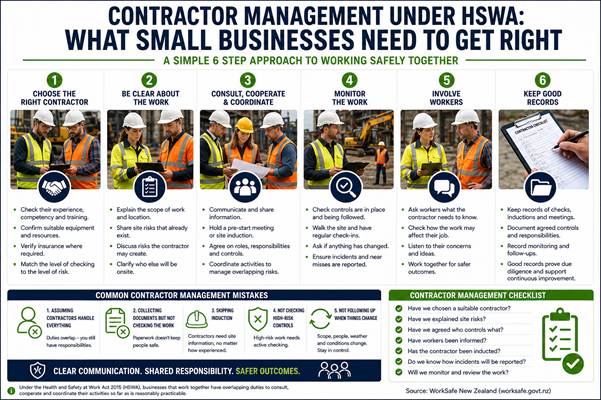
Here are the most common contractor management mistakes:
1. Assuming contractors handle everything
Contractors do have duties.
But so do you.
Shared work often means shared responsibility.
2. Asking for documents but never reading them
Collecting a safety policy is not the same as checking the work is safe.
Documents should support the job.
They should not be a box-tick.
3. Skipping induction
Even experienced contractors need site information.
They may know their trade.
They do not automatically know your site.
4. Not checking high-risk controls
If work involves machinery, vehicles, height, chemicals, or public access, controls need to be checked.
5. Not following up when things change
Weather changes.
Workers change.
Scope changes.
Plant moves.
Contractor management must stay alive during the job.
A Simple Contractor Management Checklist
Before the job starts, ask:
- Have we chosen a suitable contractor?
- Have we explained site risks?
- Have we discussed risks the contractor may create?
- Have we agreed who controls what?
- Have workers been told what is happening?
- Has the contractor been inducted?
- Do we know how incidents will be reported?
- Will we check that controls are working?
If you can answer yes, you are in a stronger position.
If not, pause and fix the gap before work begins.
A Note for Businesses Outside New Zealand
This article refers to HSWA and WorkSafe New Zealand, but contractor management is a global issue.
Australia, the UK, Canada, and many other countries use similar risk-based safety duties.
The law names may change.
The regulator may change.
The wording may differ.
But the core idea stays the same:
Choose suitable contractors.
Share risk information.
Agree responsibilities.
Monitor the work.
Keep useful records.
If you operate outside New Zealand, use this structure and align it with your local legislation.
Final Thought
Good contractor management is not about controlling every detail.
It is about clear communication.
It is about shared responsibility.
It is about making sure no risk falls between businesses.
If you regularly engage contractors and would like editable templates for contractor checks, site inductions, shared risk discussions, and contractor monitoring, our Way Safe Biz DIY Compliance Bundle is currently being developed.
You can register your expression of interest below.
Clear roles.
Clear communication.
Safer contractor work.
– Esther, Way Safe Biz
 Way Safe Biz
Leave a comment