

Many small businesses are trying to do the right thing with health and safety.
They do not want anyone hurt.
They do not want WorkSafe trouble.
They do not want messy paperwork.
They just want a simple system that works.
But health and safety can feel confusing, especially when you are busy running the business, managing staff, dealing with contractors, and keeping jobs moving.
Under the Health and Safety at Work Act 2015 (HSWA), New Zealand businesses have duties to manage workplace health and safety risks. WorkSafe explains that HSWA is New Zealand’s main workplace health and safety law, and it places duties on PCBUs, officers, workers, and others in the workplace.
The good news is this:
Most health and safety problems do not come from business owners not caring.
They usually come from small gaps that grow over time.
Let’s look at the five biggest health and safety mistakes small businesses make – and what to do instead.
Mistake 1: Thinking Paperwork Equals Safety
This is one of the most common mistakes.
A business has:
- A health and safety manual
- A hazard register
- A few policies
- Some old forms in a folder
So they think they are covered.
But paperwork alone does not keep people safe.
The real question is:
Does the paperwork match what actually happens on site?
WorkSafe says workplace assessments give businesses and workers the chance to show how they identify and manage risks. That means the focus is not just on whether documents exist.
The focus is on whether risks are being managed in real life.
A policy that no one reads is not a system.
A hazard register that never gets updated is not control.
A form that gets filled out but never acted on is not protection.
What to do instead
Keep paperwork simple, useful, and connected to real work.
Ask:
- Does this document help us manage risk?
- Do workers understand it?
- Is it being used?
- Does it match what happens on site?
Good paperwork supports safety.
It does not replace it.
Mistake 2: Not Knowing the Top Risks
Many businesses can list lots of hazards.
But they struggle to name their top risks.
That is a problem.
Not all risks are equal.
A messy lunchroom is not the same as workers near moving vehicles.
A minor trip hazard is not the same as working at height.
A missing label is not the same as chemical exposure.
WorkSafe guidance says risk management involves identifying risks, then assessing which risks to deal with first, including risks with serious consequences such as serious injury, death, or chronic ill health.
That means businesses need to focus on the risks that can cause the most harm.
What to do instead
Know your top 5–10 risks.
For example:
- Vehicle movement
- Working at height
- Machinery guarding
- Chemicals
- Fatigue
- Public interface
- Contractor work
- Manual handling
Then ask:
- How are these controlled?
- Are the controls working?
- Who checks them?
- What evidence do we have?
If you know your top risks, you can manage safety with more focus and less overwhelm.
Mistake 3: Relying Too Much on “Common Sense”
You have probably heard this before:
“They know what they’re doing.”
“They’ve done this for years.”
“It’s just common sense.”
Experience is valuable.
But experience is not a safety system.
People get tired.
People rush.
People make assumptions.
New workers copy bad habits.
Experienced workers can still miss things.
Under HSWA, a PCBU has a primary duty of care to ensure, so far as is reasonably practicable, the health and safety of workers and that other people are not put at risk by the work. WorkSafe’s introduction to HSWA explains this primary duty of care clearly.
That means businesses need more than hope and common sense.
They need clear expectations.
What to do instead
Use simple systems:
- Clear inductions
- Short toolbox talks
- Practical safe work procedures
- Training records
- Supervision for higher-risk work
- Quick checks before work starts
You do not need to make safety complicated.
But you do need to make it clear.
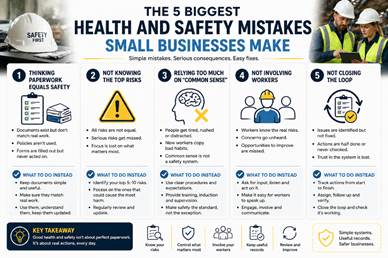
Mistake 4: Not Involving Workers
Workers often know where the real risks are.
They know which machine plays up.
They know where traffic gets tight.
They know which job gets rushed.
They know which control looks good on paper but does not work well in practice.
WorkSafe says all businesses should have planned, well-known ways to engage with workers and support their participation in health and safety matters. WorkSafe also says PCBUs must have worker engagement and participation practices, regardless of business size, risk level, or type of work.
This matters for small businesses too.
You do not need a formal committee if that does not suit your business.
But you do need a way for workers to speak up and be heard.
What to do instead
Make worker input normal.
Ask:
- What is making this job harder or riskier?
- What almost went wrong this week?
- What control is not working?
- What would make this safer?
Then act on the answers.
Worker engagement is not just talking.
It is listening, responding, and improving.
Mistake 5: Not Closing the Loop
This mistake is quiet but serious.
A business identifies a problem.
Maybe there was a near miss.
Maybe a worker raised a concern.
Maybe an inspection found an issue.
Everyone agrees it needs fixing.
Then nothing happens.
Or it half happens.
Or nobody records whether it was completed.
This is where businesses lose trust.
A safety system should show that problems are:
- Reported
- Reviewed
- Assigned
- Fixed
- Checked
If corrective actions stay open for months, the system is not working properly.
What to do instead
Use a simple corrective action register.
Track:
- What happened
- What needs to be done
- Who is responsible
- When it is due
- When it was completed
- Whether the fix worked
This does not need to be fancy.
A simple spreadsheet can be enough.
The key is follow-through.
A Simple Health and Safety Self-Check
If you run a small business, ask yourself:
- Do we know our top risks?
- Do our documents match real work?
- Are workers trained for the tasks they do?
- Do workers have a way to raise concerns?
- Do we close out actions after incidents or near misses?
- Can we explain how our controls work?
If the answer is yes, you are in a stronger position.
If the answer is no, start there.
Small improvements matter.
A Note for Businesses Outside New Zealand
This article is written with New Zealand businesses and HSWA in mind, but the core ideas apply in many countries.
Australia, the UK, Canada, and other regions also use risk-based health and safety systems.
The law names may change.
The regulator may change.
The paperwork may look different.
But the basic expectations are similar:
Identify your risks.
Control the serious ones first.
Involve workers.
Keep useful records.
Review what is working.
If you operate outside New Zealand, use this structure and align it with your local legislation.
Final Thought
Health and safety does not need to be overwhelming.
Most small businesses do not need more paperwork.
They need better structure.
Know your risks.
Use simple controls.
Involve your workers.
Keep records that reflect real work.
Close the loop when problems are found.
That is how safety becomes practical.
If you would like simple, editable templates to help manage risk assessments, worker engagement, incident follow-up, and health and safety records, our Way Safe Biz DIY Compliance Bundle is currently being developed.
You can register your expression of interest below.
Clear systems.
Useful records.
Safer businesses.
– Esther, Way Safe Biz
 Way Safe Biz
Leave a comment