

When people hear the words WorkSafe investigation, they often panic.
They imagine fines.
They imagine blame.
They imagine someone walking in with a clipboard looking for every mistake.
But in real life, a WorkSafe investigation is about one core thing:
Finding out what happened, what risks were present, and whether the business met its duties under the Health and Safety at Work Act 2015.
WorkSafe is New Zealand’s primary workplace health and safety regulator, and HSWA is New Zealand’s main workplace health and safety law.
So, if you run a business, manage workers, use contractors, or control a workplace, it helps to understand what WorkSafe may look for during an investigation.
This is general information only, not legal advice. But it will help you think clearly.
Why Would WorkSafe Investigate?
WorkSafe may investigate after a serious incident, a notifiable event, a complaint, or a situation where there may be serious risk.
WorkSafe explains that its investigation policy covers how it investigates work health and safety and energy safety issues.
Not every concern leads to a full investigation. For example, WorkSafe says it will only send an inspector to a site after a health and safety concern if the work situation could lead to death or very serious injury or illness.
That tells us something important:
WorkSafe is usually focused on serious risk, serious harm, and whether duties have been met.
1. What Was the Risk?
The first thing WorkSafe will usually want to understand is the risk.
What hazard was present?
How serious could the harm have been?
Was the risk known?
Should the business have known about it?
This links directly to the phrase reasonably practicable under HSWA.
WorkSafe guidance explains that health and safety risks must be eliminated so far as is reasonably practicable, and if they cannot be eliminated, they must be minimised so far as is reasonably practicable.
That means WorkSafe is not just asking:
“Did someone get hurt?”
They are also asking:
“Was the risk managed properly before something went wrong?”
2. What Controls Were in Place?
A control is what you put in place to reduce risk.
For example:
- Barriers
- Guarding
- Training
- Exclusion zones
- Traffic management
- Safe work procedures
- Supervision
- Emergency plans
During an investigation, WorkSafe will look at whether the controls matched the level of risk.
If the risk was serious, weak controls may not be enough.
This is where many businesses get caught.
They may have a hazard register.
They may have a policy.
They may have a form.
But the real question is:
Did the control actually protect people in practice?
3. Did Paperwork Match Real Life?
This is a big one.
WorkSafe’s assessment guidance says inspectors check that what they learn in conversations matches what is actually happening day to day.
That means your paperwork should reflect real work.
If your procedure says workers are trained, records should show that.
If your risk assessment says traffic is controlled, the site should show that.
If your safety plan says pre-starts happen, there should be evidence.
Paperwork that does not match real life creates problems.
The aim is not perfect paperwork.
The aim is truthful paperwork.
4. What Did the Business Know?
WorkSafe will also look at what the business knew, or should have known.
For example:
- Had there been previous near misses?
- Had workers raised concerns?
- Was there industry guidance?
- Had similar incidents happened before?
- Was the risk obvious?
This matters because a business cannot ignore warning signs.
If workers have raised a concern and nothing was done, that is important.
If the same issue keeps appearing in inspections or incident reports, that is important too.
A good system should show that concerns are heard, recorded, and acted on.
5. Were Workers Involved?
Worker involvement is not just a nice idea.
It is part of good health and safety practice.
WorkSafe assessments are often focused on worker involvement in health and safety, as well as the top causes of harm in each sector.
In plain English, workers should not just be handed a policy and told to get on with it.
They should be involved in identifying risks, talking about controls, reporting concerns, and improving the way work is done.
During an investigation, workers may be asked what they were told, what they understood, and what actually happened on site.
That can either support your system – or expose gaps.
6. Were Incidents and Near Misses Managed Properly?
WorkSafe may look at how the business responded to earlier events.
Ask yourself:
- Were incidents reported?
- Were near misses recorded?
- Were investigations completed?
- Were corrective actions closed out?
- Did anyone check that the fixes worked?
A near miss is not just “nothing happened.”
It is a warning.
If the same risk appears again later and causes harm, WorkSafe may look at whether the business missed the chance to act earlier.
7. Was There Clear Leadership?
If your business has officers, such as directors, WorkSafe may look at leadership and oversight.
Did leaders know the key risks?
Did they ask questions?
Did they provide resources?
Did they review safety performance?
Good leadership does not mean directors micromanage every job.
It means they stay informed and make sure the business has the time, money, equipment, and systems needed to manage risk.
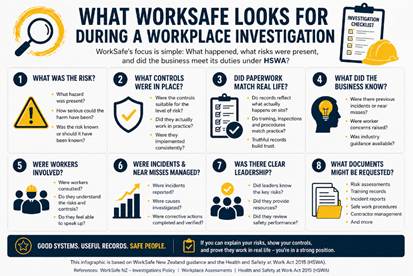
8. What Documents Might WorkSafe Ask For?
Every investigation is different, but useful documents may include:
- Risk assessments
- Training records
- Induction records
- Incident and near miss reports
- Maintenance records
- Contractor management records
- Site-specific safety plans
- Toolbox meeting notes
- Corrective action registers
- Policies and procedures
WorkSafe’s enforcement decision-making model says inspectors gather information about the nature of the risk and level of non-compliance through observation, talking with people, and looking at documents.
So yes, documents matter.
But only if they show a real system.
What Businesses Get Wrong Most
Here are the common mistakes:
- Waiting until after an incident to fix known risks.
- Having paperwork that does not match site practice.
- Not closing out corrective actions.
- Not involving workers in safety decisions.
- Assuming contractors manage everything themselves.
- Not documenting why a control was chosen.
Most of these are fixable with a simple, consistent system.
A Simple WorkSafe Readiness Check
Ask yourself:
- Can we explain our top risks?
- Can we show how they are controlled?
- Can workers explain what they do to stay safe?
- Do records match real work?
- Are incidents and near misses followed up?
- Are directors or owners actively reviewing safety?
If yes, you are in a stronger position.
If not, start there.
A Note for Businesses Outside New Zealand
This article refers to WorkSafe NZ and HSWA 2015, but the same core ideas apply in many countries.
Australia, the UK, Canada, and other regions use similar risk-based health and safety systems.
The law names may change.
The regulator may change.
The paperwork may look different.
But the core expectations are similar:
Identify risk.
Control risk.
Involve workers.
Keep useful records.
Review what is working.
If you operate outside New Zealand, apply the same structure and align it with your local legislation.
Final Thought
A WorkSafe investigation is not just about what happened on the day.
It is about what the business knew, what it did, what it documented, and whether the controls were real.
You do not need fear.
You need structure.
If you would like practical, editable templates to help document risk assessments, incident follow-up, contractor coordination, and health and safety decisions, our Way Safe Biz DIY Compliance Bundle is currently being developed.
You can register your expression of interest below.
Clear records.
Clear controls.
Safer workplaces.
– Esther, Way Safe Biz
 Way Safe Biz
Leave a comment