

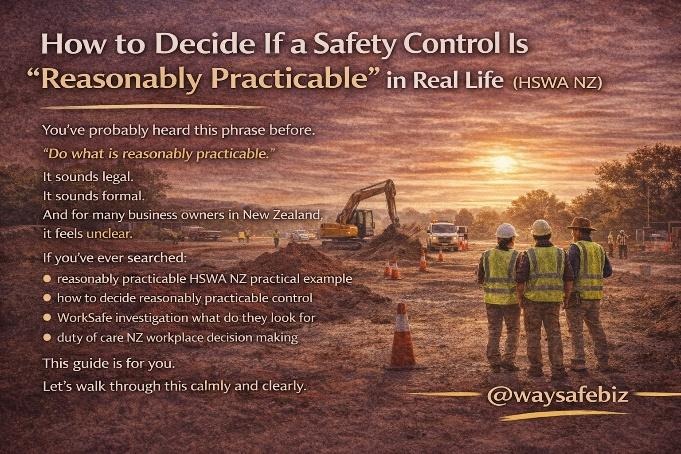
You are standing on site.
A hazard has been identified.
Maybe it is traffic near workers.
Maybe it is working at height.
Maybe it is excavation or heavy plant movement.
Now the real question comes:
“Is this control reasonably practicable under HSWA?”
This is where many business owners hesitate.
Too much control feels heavy.
Too little control feels risky.
And no one wants to fail a WorkSafe investigation in NZ.
If you have ever searched:
- reasonably practicable HSWA NZ practical example
- how to decide reasonably practicable control
- WorkSafe investigation what do they look for
- duty of care NZ workplace decision making
This guide is for you.
Let’s walk through this calmly and clearly.
Step 1: How Serious Could the Harm Be?
Start here.
Severity drives strength.
Ask yourself:
- Could someone die?
- Could someone suffer serious injury?
- Could this cause long-term health damage?
- Could this impact members of the public?
Under HSWA, your health and safety obligations in NZ require stronger controls where the harm could be severe.
If the potential outcome is fatal or life-changing, the control must be robust.
If the potential harm is minor, the control may be simpler.
WorkSafe expectations around reasonably practicable decisions are heavily influenced by the seriousness of harm.
This is central to managing workplace risk in NZ.
Step 2: How Likely Is It?
Now consider likelihood.
Is this risk:
- Rare?
- Possible?
- Likely?
- Almost certain?
Likelihood matters.
But remember this:
Low likelihood + high consequence can still require strong controls.
A trench collapse may not happen every week.
But when it does, the result can be catastrophic.
During a WorkSafe investigation in NZ, inspectors will look at both likelihood and consequence — not just frequency.
Step 3: What Do You Know (or Should You Know)?
This is where many businesses fall short.
Ask:
- Is this hazard common in our industry?
- Has WorkSafe NZ issued guidance?
- Have similar incidents happened before?
- Would a reasonable contractor know this is a risk?
Reasonably practicable under HSWA NZ includes what you should have known, not just what you personally knew.
If industry guidance exists, you are expected to be aware of it.
Ignorance is not protection under PCBU responsibilities.
This links directly to your duty of care in a NZ workplace.
Step 4: What Controls Are Available?
Now look at the hierarchy of controls.
Ask:
- Can we eliminate the risk completely?
- Can we isolate people from it?
- Can we engineer a safer solution?
- Can we change the work method?
- Can we add administrative controls?
- Is PPE required as a final layer?
Do not jump straight to paperwork.
Do not jump straight to “just wear PPE.”
Under HSWA NZ, elimination is always considered first.
If elimination is not reasonably practicable, reduction must follow.
WorkSafe expects to see that you considered safer options — not just the easiest option.
Step 5: Is the Cost Grossly Disproportionate?
Cost is the final factor.
Not the first.
You cannot simply say:
“It costs too much.”
Under the reasonably practicable meaning in HSWA NZ, cost must be grossly disproportionate to the level of risk.
If the risk involves serious harm or death, cost rarely overrides control.
If the risk is minor, simpler controls may be acceptable.
This is about balance.
Not penny-pinching.
Not gold-plating.
Balanced decision-making.
What Businesses Often Get Wrong
1️⃣ Deciding Too Fast
They identify the hazard.
They add one control.
They move on.
Pause.
Reasonably practicable decisions require structured thinking.
2️⃣ Overcomplicating Everything
Not every hazard needs a 40-page Safe Work Method Statement.
Some risks need:
- Clear signage
- A toolbox talk
- A physical barrier
- Defined exclusion zones
Simple can still meet WorkSafe expectations — if it matches the risk.
3️⃣ Ignoring Changing Conditions
Weather changes.
Crews change.
Plant moves.
Access shifts.
Scope expands.
Managing workplace risk in NZ means reviewing controls when conditions change.
A control that was reasonably practicable yesterday may not be enough today.
4️⃣ Not Documenting the Reasoning
You do not need a legal thesis.
But you should document:
- The hazard identified
- The level of risk
- The controls considered
- The control chosen
- Why it was selected
If there is ever a WorkSafe investigation NZ situation, documentation demonstrates that you met your health and safety obligations in NZ.
Memory fades.
Records remain.
A Practical “Reasonably Practicable” Checklist for Site Use
Before finalising a control, ask:
✔ What is the worst possible outcome?
✔ How likely is that outcome?
✔ What industry guidance exists?
✔ What safer alternatives were considered?
✔ Have we considered elimination first?
✔ Is our decision proportionate to the level of risk?
✔ Could we explain this clearly during a WorkSafe investigation?
If yes — you are likely operating within the reasonably practicable HSWA NZ standard.
If unsure — strengthen the control.
Real-World Example: Rural Roadside Work
You are managing contractors near a rural roadside.
Risk: Traffic striking workers.
Options:
- No signage (not reasonably practicable)
- Basic cones only (possibly insufficient)
- Full temporary traffic management (often reasonably practicable depending on speed and volume)
The higher the traffic speed and public exposure, the stronger the control required.
This is how PCBU responsibilities under HSWA are assessed in practice.
Why This Protects Directors and Business Owners
During a WorkSafe investigation NZ scenario, inspectors ask:
“Did the business consider what was reasonably practicable?”
Not:
“Was the outcome perfect?”
If you can show:
- You assessed the risk properly
- You reviewed available controls
- You selected a proportionate solution
- You documented your reasoning
…you are in a far stronger position.
Good safety decisions are calm decisions.
Structured decisions.
Documented decisions.
🌍 A Note for Businesses Outside New Zealand
While this article focuses on reasonably practicable under HSWA NZ and WorkSafe expectations, this principle exists globally.
Australia uses similar “reasonably practicable” language.
The UK applies the same test.
Canada and other jurisdictions use comparable risk-based duty of care frameworks.
The legal wording may change.
The regulator name may differ.
But the core principles remain:
Identify the risk.
Assess the level of harm.
Apply proportionate controls.
Document your reasoning.
If you operate outside New Zealand, you can apply this structured approach to managing workplace risk — simply align it with your local legislation and regulator guidance.
Final Thought
Reasonably practicable is not about guessing.
It is not about fear.
It is not about doing the bare minimum.
It is about:
Understanding your duty of care in a NZ workplace.
Managing workplace risk in a structured way.
Making balanced decisions.
Being able to explain your reasoning.
Clear reasoning reduces harm.
Clear documentation protects your business.
Clear leadership strengthens compliance.
If you would like practical, editable templates to help guide reasonably practicable decisions and demonstrate compliance with health and safety obligations in NZ — our Way Safe Biz DIY Compliance Bundle is currently being developed (designed for NZ & Australia, adaptable worldwide).
You can register your expression of interest below.
Clear structure.
Clear reasoning.
Safer worksites.
— Esther, Way Safe Biz
 Way Safe Biz
Leave a comment