

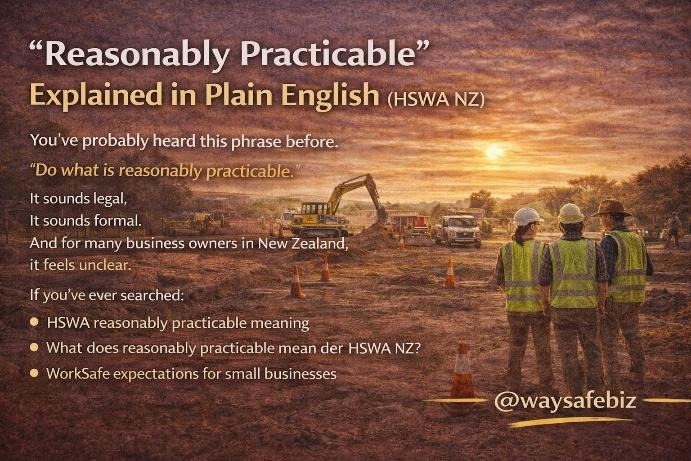
You’ve probably heard this phrase before.
“Do what is reasonably practicable.”
It sounds legal.
It sounds formal.
And for many business owners in New Zealand, it feels unclear.
If you’ve ever searched:
- HSWA reasonably practicable meaning
- What does reasonably practicable mean under HSWA NZ?
- WorkSafe expectations for small businesses
You are not alone.
Under the Health and Safety at Work Act 2015 (HSWA), every PCBU has health and safety obligations in NZ to manage risks so far as is reasonably practicable.
But what does that actually mean in real life?
Let’s break it down simply.
What Is the HSWA “Reasonably Practicable” Meaning?
In plain English, the meaning of reasonably practicable under HSWA NZ is this:
You must do what is reasonable to keep people safe, based on the level of risk, what you know about it, and what you can control.
It does not mean:
- Eliminate every single risk.
- Spend unlimited money.
- Guarantee zero harm.
- Predict the future.
It means:
Take steps that are sensible, proportionate, and realistic.
The law does not demand perfection.
It requires thoughtful management of workplace risk in NZ.
The Five Factors WorkSafe Considers
If there is a WorkSafe investigation in NZ, inspectors will assess whether your business met the “reasonably practicable” standard.
Under HSWA, five key factors are considered:
- Likelihood – How likely was the harm?
- Degree of harm – How serious could the injury be?
- Knowledge – What did you know, or what should you have known?
- Available controls – What ways existed to eliminate or reduce the risk?
- Cost – Was the cost grossly disproportionate to the risk?
These factors shape WorkSafe expectations around reasonably practicable decisions.
This is how PCBU responsibilities under HSWA are assessed.
Why This Matters for Duty of Care in NZ Workplaces
Your duty of care in a NZ workplace is directly tied to this concept.
This applies to:
- Rural contractors
- Orchard operators
- Civil construction companies
- Drainage and fencing crews
- Arborists and vegetation contractors
- Seasonal labour providers
- Small businesses managing contractors onsite
Every PCBU must actively manage health and safety obligations in NZ.
If something serious happens, WorkSafe will ask:
“Was the risk managed so far as was reasonably practicable?”
That question determines enforcement decisions.
What Businesses Get Wrong About Reasonably Practicable (HSWA NZ)
1️⃣ “We did something.”
Doing something is not automatically enough.
The control must match the level of risk.
If harm could be fatal or life-changing, stronger controls are expected.
2️⃣ “We can’t eliminate it.”
HSWA recognises that some risks cannot be eliminated.
But if elimination is not possible, reduction is required.
Managing workplace risk in NZ means reducing harm as far as reasonably practicable.
3️⃣ “It costs too much.”
Cost is considered — but last.
Under HSWA NZ, cost must be grossly disproportionate to the risk before you can justify not implementing a control.
This is often misunderstood during WorkSafe investigations.
4️⃣ “We didn’t know.”
If a hazard is widely known in your industry, ignorance is not a defence.
Reasonably practicable includes what you should have known.
WorkSafe expects businesses to stay informed about industry guidance.
5️⃣ “We’ve always done it this way.”
Tradition does not override legal duty.
If the risk was obvious and preventable, long-standing habits will not protect you.
Real Examples of Reasonably Practicable Decisions (NZ Context)
Rural Traffic Management
Risk: Workers struck by vehicles.
Reasonably practicable controls may include:
- Temporary traffic management
- Cones and signage
- Spotters
- Clear exclusion zones
Ignoring traffic control on a high-risk site would not meet WorkSafe expectations.
Working at Height in Orchards
Risk: Falls from platforms or ladders.
Reasonably practicable controls may include:
- Stable working platforms
- Guardrails
- Proper ladder systems
- Worker training
The higher the potential harm, the stronger the controls expected under HSWA.
Excavation Safety
Risk: Trench collapse.
Controls may include:
- Shoring
- Benching
- Underground service checks
- Safe access
In a WorkSafe investigation NZ scenario, these decisions would be examined carefully.
A Practical Self-Check for Businesses
Before signing off on a control, ask:
- If this went to a WorkSafe investigation, could we explain our reasoning?
- Did we assess likelihood and severity properly?
- Did we consider available industry controls?
- Did we choose a proportionate response?
- Would another reasonable contractor agree with our decision?
This is how you demonstrate compliance with PCBU responsibilities under HSWA.
What “Reasonably Practicable” Is Not
It is not:
- A loophole
- A cost-cutting shortcut
- A paperwork exercise
- A grey area to hide behind
It is structured decision-making.
It is responsible leadership.
It is meeting your duty of care in a NZ workplace.
Why This Protects Directors
Officers have due diligence duties under HSWA.
Understanding the meaning of reasonably practicable under HSWA NZ helps directors:
- Demonstrate active oversight
- Avoid underreacting to serious risks
- Avoid overcomplicating low-level risks
- Show evidence-based reasoning
WorkSafe looks closely at leadership during enforcement action.
Effort, reasoning, and proportionate control matter.
🌍 A Note for Businesses Outside New Zealand
While this article references HSWA 2015 and WorkSafe NZ, the principle of managing risk so far as is “reasonably practicable” exists in many countries.
Australia, the UK, Canada, and several other jurisdictions use similar risk-based frameworks.
The legal wording may change.
The regulator name may change.
But the core idea remains:
Identify the risk.
Assess the level of harm.
Apply proportionate controls.
Document your reasoning.
If you operate outside New Zealand, you can apply this structured risk management approach — simply align it with your local legislation.
Final Thought
The HSWA reasonably practicable meaning is not complicated.
It asks:
What is the risk?
What do we know about it?
What can we reasonably do?
Have we done enough?
Clear thinking reduces harm.
Clear documentation protects your business.
Structured decision-making supports compliance.
If you would like simple, editable tools to help document reasonably practicable decisions and demonstrate compliance with health and safety obligations in NZ — our Way Safe Biz DIY Compliance Bundle is currently in development (designed for NZ & Australia, adaptable worldwide).
Clear reasoning.
Clear leadership.
Safer workplaces.
— Esther, Way Safe Biz
 Way Safe Biz
Leave a comment