

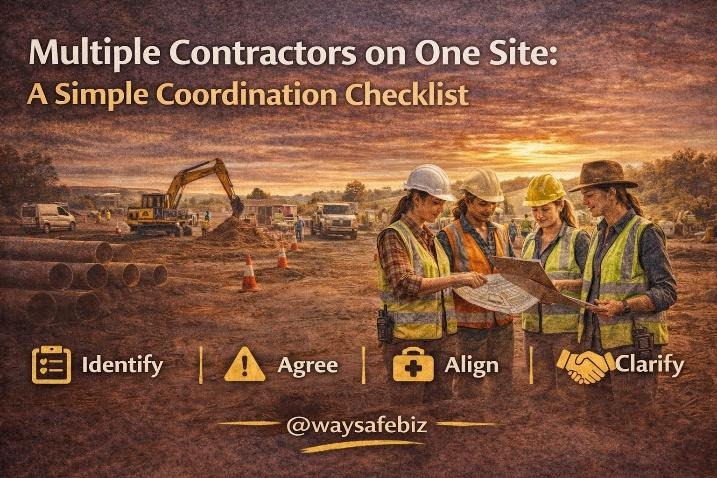
You have three contractors on site.
Machinery is moving.
Vehicles are entering and exiting.
Workers are focused on their own tasks.
One crew is excavating.
Another is fencing.
Someone else is delivering materials.
And everyone assumes someone else has “the big picture.”
This is where problems start.
Under the Health and Safety at Work Act 2015 (HSWA) in New Zealand, when multiple contractors are working together, coordination is not optional.
It is a legal requirement.
And more importantly, it is a practical safety step.
Here is a simple coordination checklist to help you manage multiple contractors calmly and clearly — without overcomplicating it.
Why Coordination Matters Under HSWA
When more than one PCBU (Person Conducting a Business or Undertaking) is working on the same site, their duties overlap.
That means each business must:
- Consult
- Cooperate
- Coordinate
If no one takes the lead on coordination, gaps appear.
And those gaps are where serious harm happens.
This is especially important in:
- Rural worksites
- Orchard blocks
- Civil construction
- Roadside vegetation works
- Drainage and fencing projects
- Seasonal contractor activity
Now let’s break it down step by step.
Step 1: Identify All PCBUs on Site
Before work starts, pause and ask:
- Who is the principal contractor?
- Who are the subcontractors?
- Who controls the overall site?
- Who controls specific tasks?
- Is the client also influencing the work?
Write it down.
Make this clear from the beginning.
Confusion at this stage leads to risk later.
If workers do not know who has authority to stop unsafe work, you already have a coordination gap.
Step 2: Agree on High-Risk Activities
Every job has risks.
List the major ones for this site:
- Working at height
- Excavations
- Traffic movement
- Machinery operation
- Working near the public
- Chemical use
- Overhead hazards
- Underground services
Then discuss:
- Who controls each risk?
- What controls are in place?
- Are controls compatible between businesses?
- Are exclusion zones clearly marked?
Do not assume systems align.
For example:
One contractor may rely on cones.
Another may rely on spotters.
Another may assume traffic control is someone else’s job.
Confirm it.
Clarity prevents conflict.
Step 3: Align Emergency Plans
If something goes wrong, everyone must respond the same way.
Ask:
- Where is the muster point?
- Who calls emergency services?
- What is the site address?
- Is first aid available?
- Are workers aware of site-specific hazards?
In rural areas, this is even more critical.
Remote locations mean slower emergency response.
Emergency confusion wastes time.
Clear planning saves lives.
Step 4: Clarify Incident Reporting
Incidents should never fall between businesses.
Agree on:
- Who reports incidents to whom?
- Who investigates?
- How findings are shared?
- Who closes corrective actions?
- When is WorkSafe notified, if required?
Near misses matter too.
They are early warnings.
If each contractor records incidents separately and does not share them, risks are missed.
Communication prevents repeat harm.
Step 5: Confirm Induction and Ongoing Communication
Make sure:
- All workers are inducted to the site
- Site rules are explained clearly
- Hazards are identified during induction
- Contact details are exchanged
- Daily changes are communicated
Induction is not a one-time event.
If a new contractor arrives mid-job, they must be brought up to speed.
If weather changes conditions, crews must be informed.
If scope changes, risks change.
Communication must continue during the job — not only before it.
Step 6: Review During the Job
Work does not stay the same.
Weather changes.
Crews change.
Access points change.
Plant moves around.
Pause and check:
- Have new risks appeared?
- Has the work area expanded?
- Are controls still working?
- Has traffic flow changed?
- Are exclusion zones still effective?
Short check-ins prevent long investigations later.
Five minutes of coordination can prevent months of legal trouble.
What This Checklist Prevents
This simple structure reduces:
- Confusion
- Blame
- Gaps in control
- Missed communication
- Repeated incidents
- Legal exposure under HSWA
It demonstrates active coordination.
And that is what HSWA expects when multiple contractors share a site.
What This Is Not
This is not:
- 200 pages of paperwork
- Complex legal language
- A heavy compliance system
- Micromanagement of other businesses
It is structured communication.
Simple. Practical. Ongoing.
You are not taking over another contractor’s job.
You are making sure risks are managed clearly.
A Final Self-Check Before Work Starts
Before the job begins, can you confidently say:
✔ We know who controls what.
✔ We have discussed high-risk tasks.
✔ We have aligned emergency plans.
✔ We know how incidents will be handled.
✔ We have inducted all workers.
✔ We will review during the job.
If yes, you are in a much stronger position.
If not, pause and coordinate.
That small step can prevent serious harm.
Why This Protects Directors and Business Owners
When multiple contractors are on one site, WorkSafe will look at coordination.
If something serious happens, they will ask:
“Did the PCBUs consult, cooperate, and coordinate?”
This checklist helps you answer yes.
Good coordination is not heavy control.
It is clear leadership.
If you regularly manage multiple contractors and want editable coordination templates designed specifically for New Zealand businesses, our Way Safe Biz DIY Compliance Bundle is currently in development.
Clear roles.
Clear communication.
Safer worksites.
🌍 A Note for Businesses Outside New Zealand
While this article references the Health and Safety at Work Act 2015 (HSWA) in New Zealand, the principle of managing risk so far as is “reasonably practicable” exists in many countries.
Australia, the UK, Canada, and several other jurisdictions use very similar risk-based frameworks.
The legal wording may change.
The expectations may vary slightly.
But the core idea remains the same:
Identify the risk.
Assess the level of harm.
Apply proportionate controls.
Document your reasoning.
If you operate outside New Zealand, you can still apply this structured approach — simply align it with your local legislation.
— Esther, Way Safe Biz
 Way Safe Biz
Leave a comment