

You have a contractor on site.
Or maybe three.
The principal contractor says they are “handling safety.”
The subcontractor assumes someone else is in charge.
The client thinks it’s covered.
And everyone quietly hopes nothing goes wrong.
Sound familiar?
Under the Health and Safety at Work Act 2015 (HSWA) in New Zealand, this situation is called overlapping duties.
And here is the key point:
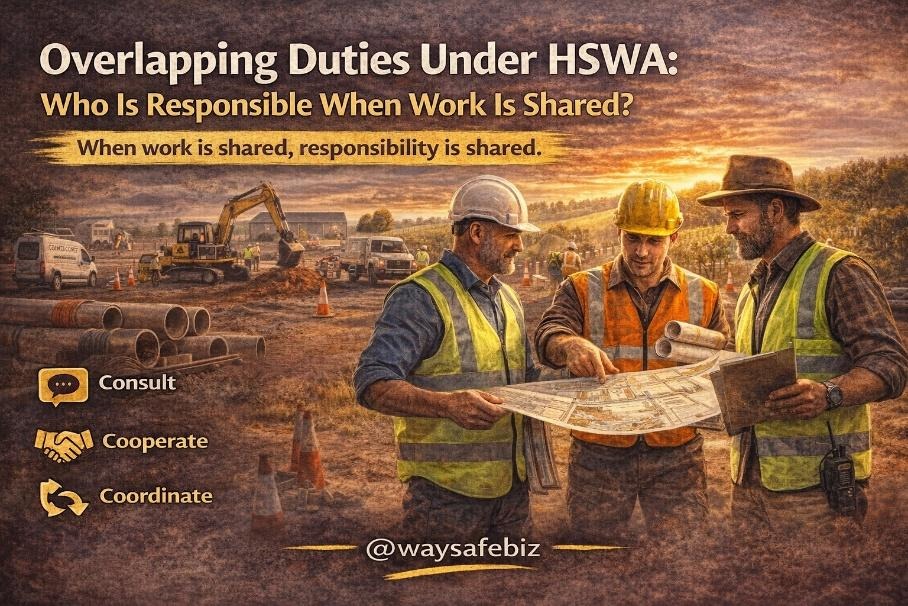
When work is shared, responsibility is shared.
You cannot hand your legal duty to someone else.
What Are Overlapping Duties?
Under HSWA, more than one PCBU (Person Conducting a Business or Undertaking) can have health and safety duties at the same time.
This happens often in New Zealand workplaces.
For example:
- A principal contractor hires subcontractors
- Multiple contractors work on one construction site
- A civil crew works near traffic controlled by another company
- A farm or orchard brings in seasonal labour crews
- A business engages external trades for maintenance
- Vegetation contractors work alongside other service providers
Each PCBU keeps their own legal duties.
Even if someone else has “overall control,” you still have responsibilities for your work, your workers, and the risks you create.
Overlapping duties are normal.
Ignoring them is the problem.
What the Law Requires
When duties overlap, HSWA requires PCBUs to:
- Consult
- Cooperate
- Coordinate
Simple words.
But very important ones.
You must talk to each other.
You must share information about risks.
You must agree on who controls what.
You must make sure safety systems align.
This is not about creating more paperwork.
It is about making sure nothing falls through the cracks.
What Businesses Get Wrong
Here are the most common mistakes we see across rural, civil, and contractor settings:
1️⃣ “The main contractor is responsible.”
No.
The main contractor may have more control of the site.
But you still have duties for your workers and your activities.
Responsibility is not transferred just because someone else is in charge overall.
2️⃣ “We assumed they had a safety system.”
Assuming is not coordinating.
You must confirm:
- What risks are present
- What controls are in place
- Whether your systems align
Silence is not consultation.
3️⃣ “We sent them our safety manual.”
Sending documents is not enough.
Coordination means discussion.
It means asking questions.
It means agreeing clearly on responsibilities.
4️⃣ “Everyone is experienced.”
Experience reduces some risk.
It does not remove legal duties.
Experienced workers can still make mistakes.
Systems must still be aligned.
5️⃣ “We’ve worked together for years.”
Familiarity feels safe.
But risk still exists.
Every new job can introduce new hazards.
Overlapping duties are not about blame.
They are about shared risk.
Why This Matters in Rural and Contractor Settings
This is especially relevant for:
- Rural contractors
- Orchard operators
- Civil contractors
- Fencing crews
- Drainage contractors
- Vegetation and arborist teams
- Seasonal labour providers
Think about real risks:
- Traffic management on rural roads
- Working at height in orchards
- Excavations near other crews
- Machinery moving through shared accessways
- Chemical spraying near the public
- Contractors entering active farm blocks
When multiple businesses operate together, risk increases.
Without coordination, small gaps appear.
Those gaps are where serious incidents happen.
And when something serious happens, WorkSafe will look closely at who communicated — and who did not.
What “Good” Overlapping Duties Look Like
Overlapping duties managed well look simple and practical.
✔ A pre-start meeting before work begins
✔ Clear agreement on who controls specific risks
✔ Shared understanding of high-risk tasks
✔ Emergency plans discussed and aligned
✔ Contact details exchanged
✔ Clear incident reporting process
✔ Regular check-ins if work changes
It does not need to be complex.
It needs to be intentional.
A Simple Reality Check
Ask yourself before work starts:
- Have we clearly discussed high-risk activities?
- Do we know who controls traffic management?
- Do we know who manages inductions?
- Do we know who reports incidents?
- Do we know who has authority to stop unsafe work?
If the answers are unclear, coordination needs strengthening.
Clarity reduces confusion.
Confusion increases risk.
What Overlapping Duties Are Not
They are not:
- A one-page form signed and forgotten
- A box-ticking exercise
- A single conversation at the start of the job
- A transfer of blame
They are ongoing.
As work changes, risk changes.
As crews change, communication must continue.
HSWA expects active coordination — not passive hope.
Why This Protects Your Business
Clear coordination:
- Reduces incidents
- Protects workers
- Protects the public
- Protects directors
- Protects your reputation
- Reduces legal exposure
If something serious happens, WorkSafe will ask:
“Who was responsible for managing this risk?”
The strongest answer is:
“We consulted, cooperated, and coordinated clearly.”
Not silence.
Not confusion.
Not finger-pointing.
Final Thought
Shared work means shared responsibility.
Overlapping duties under HSWA are not designed to make life harder.
They are designed to make risk clearer.
When businesses talk early and talk clearly, most problems are preventable.
If you regularly work alongside other contractors and want simple, practical templates to manage overlapping duties properly, we are currently developing the Way Safe Biz DIY Compliance Bundle for New Zealand businesses.
Clear communication.
Clear roles.
Safer outcomes.
🌍 A Note for Businesses Outside New Zealand
While this article references the Health and Safety at Work Act 2015 (HSWA) in New Zealand, the principle of managing risk so far as is “reasonably practicable” exists in many countries.
Australia, the UK, Canada, and several other jurisdictions use very similar risk-based frameworks.
The legal wording may change.
The expectations may vary slightly.
But the core idea remains the same:
Identify the risk.
Assess the level of harm.
Apply proportionate controls.
Document your reasoning.
If you operate outside New Zealand, you can still apply this structured approach — simply align it with your local legislation.
— Esther, Way Safe Biz
 Way Safe Biz
Leave a comment