

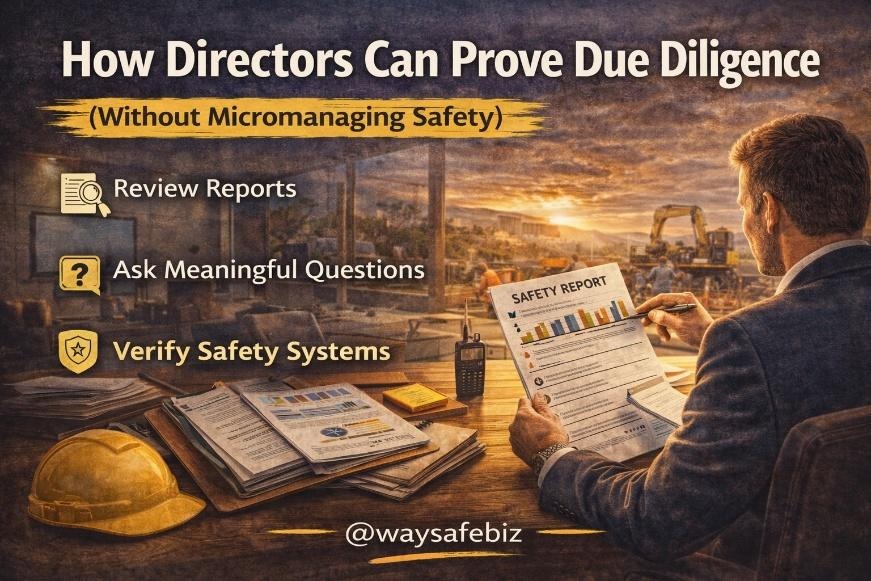
Many directors understand they have due diligence duties under HSWA.
But they ask:
“How do I prove I’m meeting them… without running the toolbox meetings myself?”
Good question.
You do not need to micromanage safety.
You need evidence of active governance.
Here’s how to do that in a practical, calm way.
Step 1: Set a Clear Safety Reporting Rhythm
Create a simple reporting structure.
This might be:
- Monthly safety summary
- Quarterly board-level review
- Dashboard of top risks
Reports should cover:
- Incidents and near misses
- High-risk activities
- Outstanding corrective actions
- Training status
Consistency is what proves oversight.
Step 2: Ask Better Questions
You do not need technical detail.
You do need meaningful questions.
For example:
- What are our top three risks this month?
- Have there been any serious near misses?
- Are any controls failing?
- Are contractors being reviewed properly?
Document that these questions were asked.
Meeting minutes matter.
Step 3: Visit the Workplace Occasionally
You do not need to supervise daily work.
But occasional site visits show engagement.
When visiting:
- Observe conditions
- Ask workers how systems are working
- Check visible controls
Even simple engagement demonstrates active interest.
Step 4: Ensure Training and Competency Is Tracked
Ask for evidence that:
- High-risk roles are trained
- Competencies are recorded
- Refresher training happens
You are not checking every certificate.
You are confirming the system exists and functions.
Step 5: Review Incidents and Close-Out Actions
Do not let incidents disappear.
Ensure:
- Investigations happen
- Root causes are identified
- Actions are tracked
- Close-out is documented
If actions stay open for months, that is a governance issue.
Step 6: Confirm Resources Are Adequate
Ask:
- Do we have enough time allocated to safety?
- Are budgets realistic?
- Is plant maintained properly?
Under HSWA, due diligence includes ensuring resources are available.
What Micromanaging Looks Like (And What to Avoid)
Micromanaging is:
- Approving every JSA personally
- Attending every toolbox talk
- Overriding operational supervisors
- Controlling day-to-day tasks
That is not governance.
Governance is:
- Oversight
- Review
- Verification
- Direction
Let operational leaders manage work.
You verify that they are doing so effectively.
How to Create Evidence of Due Diligence
If WorkSafe ever asked, you should be able to show:
- Board meeting minutes referencing safety
- Regular reports
- Action tracking records
- Resource approvals
- Policy reviews
- Site visit notes
This is what proves officer due diligence.
Why This Approach Works
It protects you without creating chaos.
It builds:
- Accountability
- Transparency
- Continuous improvement
And it keeps directors in the right lane — governance, not operations.
If you are unsure whether your governance-level safety structure would stand up to scrutiny, that is exactly what we help with at Way Safe Biz.
We are also developing a practical DIY Compliance Bundle with templates designed for New Zealand directors and business owners who want structure without unnecessary admin.
You can register your interest below.
Strong governance does not mean heavy control.
It means informed leadership.
🌍 A Note for Businesses Outside New Zealand
While this article references the Health and Safety at Work Act 2015 (HSWA) in New Zealand, the principle of managing risk so far as is “reasonably practicable” exists in many countries.
Australia, the UK, Canada, and several other jurisdictions use very similar risk-based frameworks.
The legal wording may change.
The expectations may vary slightly.
But the core idea remains the same:
Identify the risk.
Assess the level of harm.
Apply proportionate controls.
Document your reasoning.
If you operate outside New Zealand, you can still apply this structured approach — simply align it with your local legislation.
— Esther, Way Safe Biz
 Way Safe Biz
Leave a comment