

If you run a business in New Zealand, you may have heard the word PCBU.
But you might still be wondering:
“Does that actually apply to me?”
Many small business owners think health and safety law is only for big companies.
It’s not.
Under the Health and Safety at Work Act 2015 (HSWA), most businesses are classed as a PCBU (Person Conducting a Business or Undertaking).
In our previous article, “PCBU duties in plain English (and what businesses get wrong most),” we explained what a PCBU is and what the main duties involve.
Now let’s make it practical.
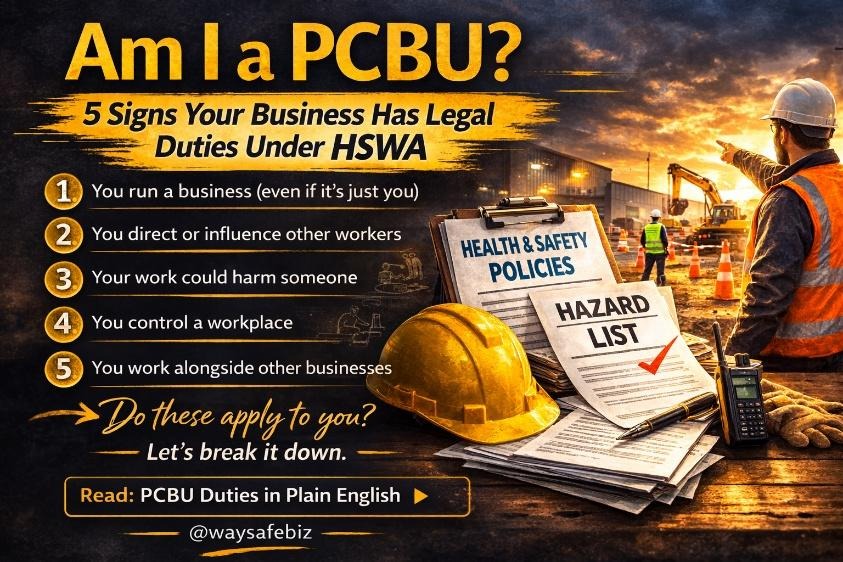
Here are 5 clear signs your business has legal duties under HSWA.
1️⃣ You Run a Business (Even If It’s Just You)
If you are:
- A sole trader
- A self-employed contractor
- A limited company
- A partnership
- A trust running a business
You are very likely a PCBU.
You do not need employees to have duties.
If you are running work for profit (or even regularly), the law usually applies.
Even one-person operations must make sure their work does not harm:
- Themselves
- Other workers
- Clients
- Members of the public
If you are “running the work,” you are probably a PCBU.
2️⃣ You Direct or Influence Other Workers
If you:
- Hire staff
- Use subcontractors
- Direct labour crews
- Control how work is done
You have legal health and safety duties.
You must make sure:
- Risks are identified
- Controls are in place
- Workers are trained
- Work is supervised properly
You cannot say, “They’re experienced, they’ll figure it out.”
Under HSWA, you must take steps that are reasonably practicable to keep people safe.
3️⃣ Your Work Could Harm Someone
Ask yourself:
Could my work cause serious harm if something went wrong?
For example:
- Working at height
- Using chainsaws
- Operating machinery
- Handling chemicals
- Moving vehicles
- Working near the public
If the answer is yes, then you have duties.
The law focuses on real risk — not just paperwork.
If your work has risk, you have responsibility.
4️⃣ You Control a Workplace
If you own, lease, or manage:
- A yard
- A workshop
- An orchard block
- A depot
- A building site
- A packhouse
You likely have extra duties.
When you control a workplace, you must make sure it is safe so far as is reasonably practicable.
That includes:
- Traffic flow
- Housekeeping
- Signage
- Exclusion zones
- Maintenance
Even if contractors are working there, you still have responsibilities.
This links closely to overlapping duties, which we will cover further in future articles.
5️⃣ You Work Alongside Other Businesses
If you work with:
- Principal contractors
- Subcontractors
- Clients
- Other crews
You share responsibility.
Under HSWA, multiple PCBUs must:
- Consult
- Cooperate
- Coordinate
If you assume “someone else is handling safety,” that can create serious gaps.
Shared work means shared duties.
Common Signs You Might Be Unsure
Many business owners say:
“I only have one worker.”
“It’s just casual staff.”
“We’re a small rural contractor.”
“I thought the main contractor handled it.”
Size does not remove responsibility.
Small businesses still have duties.
The good news is this:
You do not need a massive 200-page safety manual.
You need:
- Clear risk controls
- Simple procedures
- Training evidence
- A working system
In our article “PCBU duties in plain English (and what businesses get wrong most),” we break down exactly what those duties look like in real life. If you haven’t read it yet, start there.
👉 Read: PCBU Duties in Plain English
Quick Self-Check: Are You a PCBU?
If you answer “yes” to any of these, you likely have duties under HSWA:
- I run a business or contracting service.
- I control how work is done.
- I manage a workplace or yard.
- My work involves real risk.
- I work alongside other contractors.
If you answered yes to even one, you should understand your obligations.
Why This Matters
Being a PCBU is not about fear.
It is about:
- Protecting workers
- Protecting the public
- Protecting your business
- Protecting directors
Ignoring PCBU duties does not make them go away.
But understanding them makes them manageable.
What Should You Do Next?
Start simple:
- Identify your top risks.
- Check if controls are in place.
- Make sure workers are trained.
- Review how you manage contractors.
- Document what actually happens.
If you want a step-by-step structure and editable templates to guide you, we are currently building a Way Safe Biz DIY Compliance Bundle designed specifically for New Zealand businesses.
You can register your expression of interest below to receive:
- Early access
- A free sample template pack
- Launch-only updates
👉 Join the Waitlist Here
Clear duties. Clear systems. Clear leadership.
🌍 A Note for Businesses Outside New Zealand
While this article references the Health and Safety at Work Act 2015 (HSWA) in New Zealand, the principle of managing risk so far as is “reasonably practicable” exists in many countries.
Australia, the UK, Canada, and several other jurisdictions use very similar risk-based frameworks.
The legal wording may change.
The expectations may vary slightly.
But the core idea remains the same:
Identify the risk.
Assess the level of harm.
Apply proportionate controls.
Document your reasoning.
If you operate outside New Zealand, you can still apply this structured approach — simply align it with your local legislation.
— Esther, Way Safe Biz
 Way Safe Biz
Leave a comment