

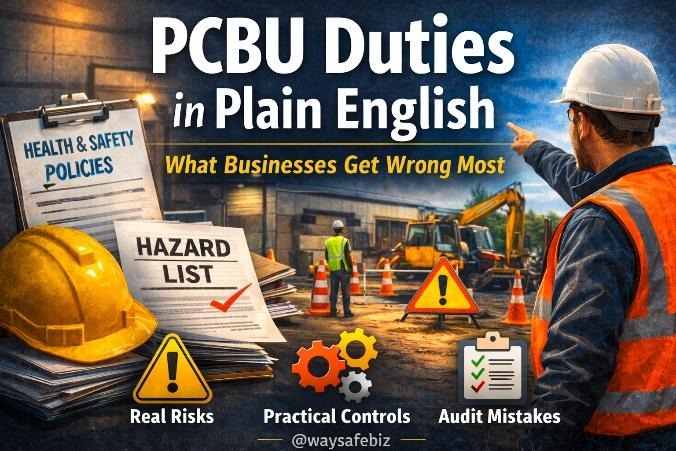
If you run a business in New Zealand — whether you’re a one-person band, a contractor with a small crew, or a company managing multiple sites — there’s a high chance you’re a PCBU (Person Conducting a Business or Undertaking).
And here’s the truth: most businesses think they’re doing “health and safety” because they’ve got a folder of policies… but what the law actually expects is practical control of real risk.
This post breaks down PCBU duties in plain English, plus the most common mistakes that quietly fail businesses during audits, incidents, or contractor reviews.
Quick note: This is general information (not legal advice). If you want help applying it to your specific operation, that’s exactly what we do at Way Safe Biz.
What is a PCBU (in real-life terms)?
A PCBU is basically the person or business that is running the work.
That can include:
- companies and partnerships
- sole traders / self-employed contractors
- trusts
- incorporated societies
WorkSafe has a helpful plain-English explainer on PCBU responsibilities and the “primary duty of care.”
The core PCBU duty: keep people safe “so far as is reasonably practicable”
Under the Health and Safety at Work Act 2015 (HSWA), PCBUs have a primary duty of care.
In normal language, that means you must take reasonable steps to ensure people aren’t harmed by your work — including:
- your workers
- contractors you influence or direct
- visitors and others who could be affected by the work (where relevant)
That key phrase “so far as is reasonably practicable” matters. It means you’re expected to do what is reasonable given the risk, what you know (or should know), and the availability/suitability of controls — not what’s “convenient” or “what we’ve always done.”
What PCBUs must actually do (the practical checklist)
Here’s a plain-English way to think about your PCBU obligations.
1) Identify hazards and manage risks (not just write them down)
A PCBU must manage work health and safety risks — ideally by eliminating them, and if that’s not possible, minimising them using effective controls (not wishful thinking).
What this looks like on a real site:
- separating people from moving vehicles and machinery
- safe systems for working at height
- clear chemical handling + spill response controls
- fatigue and heat stress controls during peak season work
2) Provide safe systems of work, equipment, and information
This includes things like:
- safe procedures for high-risk tasks
- maintained plant and equipment
- training and supervision appropriate to the work
- information and instruction people can actually follow
3) Protect other people affected by the work
This is where public-interface work, customer sites, shared yards, orchards, and multi-contractor sites matter. HSWA is not only about your direct employees.
4) Work together when multiple businesses share a site
If you share duties with another PCBU (for example: client + contractor + subcontractor), you must consult, cooperate, and coordinate (often called the “3 Cs”) so risks are managed properly.
WorkSafe is also very clear that they expect PCBUs to explain what they did to consult/cooperate/coordinate — and may take action against multiple businesses if overlapping duties aren’t met.
5) If you manage or control the workplace, you have extra duties
If you control the workplace (a yard, orchard blocks, depot, workshop, office, packhouse, etc.), there are additional obligations around ensuring the workplace itself is safe, so far as reasonably practicable.
What businesses get wrong most (and why it hurts later)
This is the stuff we see all the time — especially in rural contracting, orchards, and small-to-medium NZ operations.
Mistake #1: “We have a hazard register, so we’re covered.”
A hazard register is not a magic shield.
If it lists hazards but doesn’t lead to:
- practical controls
- daily checks
- supervision
- training evidence
- fixes happening in real time
…then it’s paperwork, not protection.
Audit pain point: Hazard register says “working at height managed” but ladder use is uncontrolled, no inspection records, and no site-specific plan.
Mistake #2: confusing documents with systems
Policies are not a system.
A system is: how work actually happens + proof it’s managed.
A working system usually includes:
- risk assessment method people use consistently
- simple SOPs for high-risk tasks
- induction + training records
- incident + near miss process (with follow-through)
- contractor management process
- review rhythm (monthly/quarterly)
Mistake #3: “My workers are experienced — they already know.”
Experience helps… until the day it doesn’t.
The law expectation is that you provide instruction, training, and supervision appropriate to the work and risk — and you can show it happened.
Common gap: no evidence of competency for chainsaws, forklifts, chemical handling, working at height, or even site-specific hazards.
Mistake #4: Overlapping duties are treated like a “them problem”
This one bites hard.
Businesses assume:
- “the principal will handle safety”
- “the contractor will handle safety”
- “the subbie will figure it out”
But HSWA requires shared PCBUs to consult, cooperate and coordinate so risks don’t fall through the cracks.
Real-world example:
Client assumes contractor has traffic management sorted. Contractor assumes client has site layout risks controlled. No one agrees on vehicle routes. Near miss happens. Everyone is suddenly interested.
Mistake #5: “Reasonably practicable” gets misused as “too hard / too expensive”
“Reasonably practicable” is not a loophole. It’s a risk-based test.
High consequence risks (serious harm/fatality potential) typically require strong controls and better evidence.
If there’s a serious incident and you can’t show why a control wasn’t reasonably practicable (or what you did instead), you’re exposed.
Mistake #6: Directors/owners think PCBU duty is only for the safety person
Leadership matters.
Officers (directors and similar governance roles) have a due diligence duty to ensure the PCBU meets its obligations.
WorkSafe’s position explains that due diligence is proactive — it’s not “set and forget.”
A simple “PCBU compliance reality check” (use this today)
If you can answer yes to these, you’re typically in a much safer place:
- We can explain our top 10 risks and our actual controls (not just list hazards).
- High-risk tasks have a clear method (SOP / SWMS / JSA) that workers follow.
- Inductions happen and are recorded (workers + contractors).
- Training/competency is tracked (even if it’s simple).
- Incidents and near misses are reported and actions are closed out.
- We coordinate with other PCBUs on shared sites (3 Cs).
- Our workplace (yard/site) has practical controls: signage, traffic flow, exclusions, housekeeping.
- Leadership reviews safety performance (not just after something goes wrong).
If you’re reading that list and thinking “we’re close but not consistent” — that’s exactly where most businesses sit. The fix is usually structure + templates + a realistic routine, not a total overhaul.
FAQ
Are sole traders PCBUs?
Often, yes. HSWA includes PCBUs who are self-employed and requires them to ensure their own health and safety while at work, so far as reasonably practicable.
Do I need a big fancy safety manual?
Not necessarily. What you need is a fit-for-purpose system: the right documents, the right controls, and evidence that it’s used.
What’s the fastest way to improve PCBU compliance?
Focus on the highest risk first:
- identify top risks
- strengthen controls
- document the method (simple)
- capture proof (training, pre-starts, inspections, close-outs)
Want the “done-with-you” shortcut?
At Way Safe Biz, we build simple, audit-ready systems that match how small NZ businesses actually work — especially rural contractors and orchard operators.
If you’d like the DIY version, keep an eye out for our H&S + Environmental ebook bundles (with editable templates) — designed to help you build compliant systems without drowning in admin.
And if you want it tailored to your operation, contact us and we’ll map it properly.
🌍 A Note for Businesses Outside New Zealand
While this article references the Health and Safety at Work Act 2015 (HSWA) in New Zealand, the principle of managing risk so far as is “reasonably practicable” exists in many countries.
Australia, the UK, Canada, and several other jurisdictions use very similar risk-based frameworks.
The legal wording may change.
The expectations may vary slightly.
But the core idea remains the same:
Identify the risk.
Assess the level of harm.
Apply proportionate controls.
Document your reasoning.
If you operate outside New Zealand, you can still apply this structured approach — simply align it with your local legislation.
— Esther, Way Safe Biz
 Way Safe Biz
Leave a comment